Posts

A Pelican in Peril

Image
April 21, 2018 -- A sick pelican sat in the middle of the road, just ahead of me, on Castaways Lane.  In the early morning in late April, these streets are quiet.  Maybe I was the first person to see the sick pelican, as I nearly completed my hour-long walk.  I hoped he wasn't sick; perhaps he'd just consumed a large fish and was temporarily impaired.  So I walked the short distance of Tropical Way and back, hoping to find that the pelican had flown away. No, the big bird was still there, stubbornly sitting smack in the middle of the blacktop.  Something was wrong with him; my guess was that red tide poisoning was his problem.  I've taken small birds to CROW (Care and Rehabilitation of Wildlife -- a wildlife hospital on Sanibel Island) in the past.  But I'm not trained in how to handle big birds.  So I called CROW.  Thank heavens for mobile phones!  I wanted to call my neighbor Jim, whom I know does rescue big birds regularly....
Clean Water for Charleston Park

Margaret Mead famously said, “Never doubt that a small group of thoughtful, committed citizens can change the world; indeed, it's the only thing that ever has.”  It happened recently in Lee County. On the last weekend of October 2017, the News-Press published an exposé about a drinking water quality problem in Charleston Park – a rural community of about 112 households, between Alva and LaBelle.  Most people living there use wells to supply water to their homes.  For decades, Lee County officials have known that water from these wells is filled with bacteria and nitrates, but the problem was never adequately addressed.  The county has no legal obligation to solve problems with drinking water from private wells. After reading the exposé, a small number of people from various parts of the county were sufficiently concerned about this continuing problem that they contacted the News-Press reporter, Janine Zeitlin, who wrote most of the articles in the exposé....

The Wild West of Sanibel, Part 2

Image
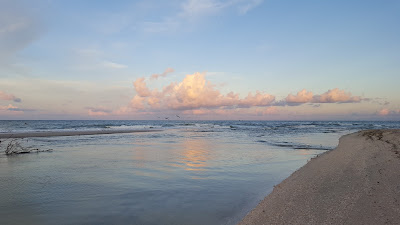
September 30, 2016 -- My new Autumn routine includes a 3-mile walk early in the morning, in addition to my usual 2-kilometer swim in the pool at mid-day.  The walk always includes at least a few minutes on the beach; the rest is along the shared-use path. If conditions are good (low-ish tide, no rainstorms threatening, not too much hot sun), I will walk on the beach the entire way to the trail head on Silver Key.  There, I can either take the trail or continue along the beach. Continuing along the beach requires some nimble maneuvering around, through, and over some dead trees -- trees whose lives were claimed by the Gulf of Mexico. Looking out at the Gulf from the opening at Old Blind Pass this morning The great reward, after maneuvering through the trees-turned-into-driftwood-statues, is that I reach the point where Clam Bayou/Old Blind Pass now meet the Gulf of Mexico.  For years, this meeting of the waters did not exist; the sandy beach separated the bayous f...

What it means to be green

Image
June 24, 2016 -- The Grand Floridian Resort is, surprisingly, a member of Florida's Green Lodging Program, in spite of the fact that the resort has created an environmental no-no on its property: fake beach on the lagoon that I blogged about on June 16 . A Florida alligator.  The red-brown stain in this water is from natural tannins in native vegetation. According to the Green Lodging Program's web site, "The Florida Green Lodging Program is a voluntary initiative of the Florida Department of Environmental Protection (DEP) that designates and recognizes lodging facilities that make a commitment to conserve and protect Florida’s natural resources. The program’s environmental guidelines allow the hospitality industry to evaluate its operations, set goals and take specific actions to continuously improve environmental performance." I wrote to the Florida DEP's ombudsman office to suggest that one of the program's environmental guidelines should be t...

Speak their names

Image
June 21, 2016 -- "One year ago," Pastor John said on Sunday, "during the sermon I read the list of names of the victims of the shooting in Charleston."  This time, in the aftermath of the massacre in Orlando, he wanted help.  He had asked Paul and me to share the reading of the names during a prayer after the sermon. I thanked him for the opportunity to do something to help the families of the victims. Lifting their loved ones' names up in prayer was something we could do. After researching and practicing the pronunciation of the names given to me to read on Saturday, I was ready.  I speak French, not Spanish, but I tried. I wanted to give the respect of saying these young people's names correctly. That was Sunday.  The next day was Monday, yesterday, the longest day of the year.  The full moon rose in the sky.  Monday evening was also the time that most of our night-blooming cereus bloomed.  These glorious, strange blossoms burst out exuberant...

Guilty: The Grand Floridian

Image
Florida lagoons, ponds, and lakes should be surrounded by native vegetation. June 16, 2016 -- I used to write newspaper articles about alligators on Sanibel Island.  More specifically, I wrote about incidents involving alligators, as recorded in police reports.  My goal was to explain that complaining to the police about an alligator's presence was a death sentence to the alligator, especially if it is over 6 feet long.  Those reported alligators are killed; the smaller ones are relocated.  I stopped writing those articles when I began to suspect that they were reminding some people that they could get rid of any alligator by simply calling the police. Alligator eating a bowfin fish behind our former home. Indeed, alligators who show no fear of humans are dangerous.  But most alligators are not dangerous to humans, because they fear and avoid them.  What makes alligators lose that fear?  People who feed alligators, that's what.  Almost a...

Go Mangrove!

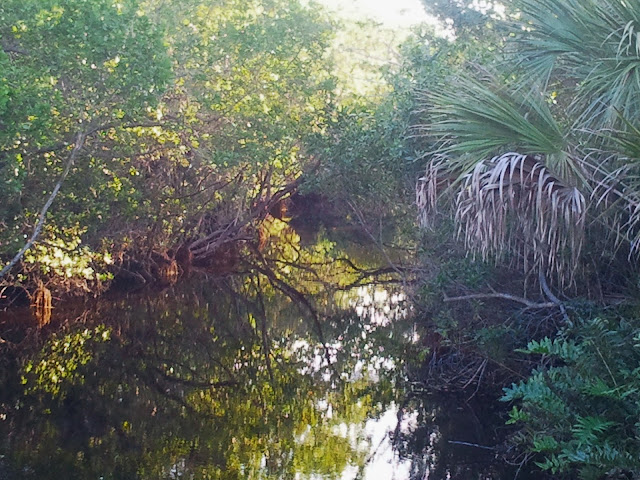
Image
April 16, 2016 -- In April 2013, this is what I said about mangroves during the "mission moment" at church: When you live in this part of Florida, you know or you soon learn that native plants are important to our ecosyste m. Mangrove trees are true natives, and they are our most valuable coastal resource. Biologically, they form the structure for a complex ecosystem that is the link between the land and the sea. These mangroves stabilize our shorelines. Their root systems slow water flow, and that facilitates the deposit of organic material and sediment that provide nutrients that are the basis of the marine life food chain. Excess nutrients such as nitrogen and phosphorus are filtered from coastal waters by mangroves, and are incorporated into the leaves, branches and root systems of the trees. Mangroves are important to fish. About 85 to 90 percent of all local commercial and recreational fish depend on mangroves for food and shelter. Other marine organisms attach to...