Posts

Showing posts with the label Sanibel

In the Days of Roger and Lucia

Image
When Roger and Lucia Wilcox would come to their winter home on Sanibel Island in the 1950s and 1960s, they led a relatively quiet life.  People on Sanibel were aware that the couple was well-known in the East Hampton, New York, artists’ world, where they often entertained and organized events.  In Long Island, their names were frequently in the newspapers.  But Sanibel people respected their privacy. Lucia Anavi was born in Beirut in 1902.   Her mother was French, and her father was Lebanese.    Early in life, she started to become a gifted painter, sculptor, and cook.   So at age 14, she left home to live in Paris. There she became a part of a legendary group of artists, including Piet Mondrian, Picasso, Marc Chagall, Carlos Montoya, Max and Jimmy Ernst, and many more.   Some of them encouraged her to go to night school, so she enrolled in the Académie Ronsard. In 1938, she and her partner at the time, Fernand Leger, left Paris for New York...

Ghost forests are not all bad

Image
A ghost forest is an area of dead or dying trees.  Ghost forests that are appearing in coastal Florida these days are generally caused by rising sea level -- the increasing intrusion of salt water into a habitat that once supported trees that were not so salt- or water-tolerant. The trees die, leaving only their upright, dead skeletons -- called snags -- and eroded roots behind. A snag on Silver Key, decorated with shells. But there is a ghost forest area on Silver Key in Sanibel that was caused more directly by humans.  Years ago, the City of Sanibel killed the invasive exotic Casuarina (Australian Pine) trees on Silver Key.  Many of the snags have now fallen, but some remain, and a few of them support osprey nests. The remaining salt marsh on Silver Key appears to be thriving.  Much of it is savanna-like.  Part of it is wooded with sea grapes and buttonwoods.  And then there's the beach side of Silver Key, which is in a constant state of change. ...

Walking the ever-changing beach

Image
I begin my morning walk by just ambling down the lane on the hushed and heavily wooded Porpoise Point, heading south along the aptly named Coconut Drive.   On  breezy days like this, I avoid walking directly beneath the taller, fruit-laden coconut trees.    One day last week, a cannonball-size coconut fell to the pavement right in front of my car as I drove home on Coconut Drive.   The impact was so great that a gush of coconut water shot up from the cracked husk.   I felt blessed that I was no longer driving a Miata, but a CX-3 instead. As I began my walk this morning, I thought about which route to take.   On a windy day, I might not opt to walk on the beach because I do not wish to be sandblasted. Being sandblasted hurts.   But this morning was simply breezy in a blustery way.   When I could see Sunset Bay as I passed the cute, old beach cottages across from Castaways Lane, I could see the exposed sandbar.   Hmmm. Tide is lo...

Can Sanibel Walk the Walk?

Image
After hearing dozens of citizens complaining loudly about the air pollution and noise emitted by gas-powered leaf blowers, the Sanibel City Council reacted by merely reducing the hours that these devices can be used by commercial landscapers and city employees.  Because a few landscapers do not want their workers to wait until 9AM to start working, they have replaced the gas-powered blowers with more environmentally friendly electric ones. That ordinance was passed by the Council in December, but even as the Council members passed it, they acknowledged that they need to do more to reduce or eliminate the use of these pollution spewing machines. No gas-powered leaf blowers are used here. In January, they shocked the citizens by doing as little as possible: they passed a resolution to "encourage individuals and businesses to voluntarily use environmentally friendly alternatives to gas-powered landscape equipment, including electric and battery equipment, in addition to manua...

A Pelican in Peril

Image
April 21, 2018 -- A sick pelican sat in the middle of the road, just ahead of me, on Castaways Lane.  In the early morning in late April, these streets are quiet.  Maybe I was the first person to see the sick pelican, as I nearly completed my hour-long walk.  I hoped he wasn't sick; perhaps he'd just consumed a large fish and was temporarily impaired.  So I walked the short distance of Tropical Way and back, hoping to find that the pelican had flown away. No, the big bird was still there, stubbornly sitting smack in the middle of the blacktop.  Something was wrong with him; my guess was that red tide poisoning was his problem.  I've taken small birds to CROW (Care and Rehabilitation of Wildlife -- a wildlife hospital on Sanibel Island) in the past.  But I'm not trained in how to handle big birds.  So I called CROW.  Thank heavens for mobile phones!  I wanted to call my neighbor Jim, whom I know does rescue big birds regularly....

The Wild West of Sanibel, Part 2

Image
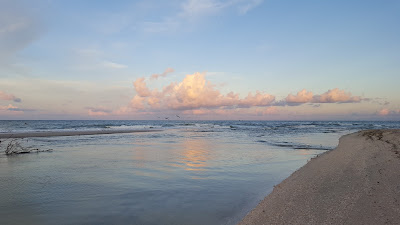
September 30, 2016 -- My new Autumn routine includes a 3-mile walk early in the morning, in addition to my usual 2-kilometer swim in the pool at mid-day.  The walk always includes at least a few minutes on the beach; the rest is along the shared-use path. If conditions are good (low-ish tide, no rainstorms threatening, not too much hot sun), I will walk on the beach the entire way to the trail head on Silver Key.  There, I can either take the trail or continue along the beach. Continuing along the beach requires some nimble maneuvering around, through, and over some dead trees -- trees whose lives were claimed by the Gulf of Mexico. Looking out at the Gulf from the opening at Old Blind Pass this morning The great reward, after maneuvering through the trees-turned-into-driftwood-statues, is that I reach the point where Clam Bayou/Old Blind Pass now meet the Gulf of Mexico.  For years, this meeting of the waters did not exist; the sandy beach separated the bayous f...

Come Back Anytime

Image
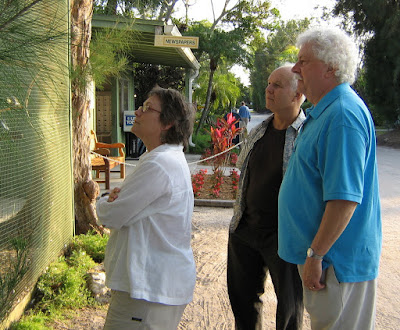
April 4, 2016 -- Some people bring joy everywhere they go.  Our friend Dan Barnes was one of those blessed folks.  And so is Holly Downing, his wife. Tom and I know them from our years living in Columbus.  We were delighted when they came to visit us in Sanibel ten years and two months ago -- January 2006. We dined al fresco at Doc Ford's the first night of their visit, and the second night, we had accepted an invitation to an open-house cocktail party for prospective members at The Sanctuary Golf Club. We're no golfers, but I'm a serious swimmer, and the pool at the city's recreation center was closed, or about to be closed.  I was hoping that the recent renovations at The Sanctuary included an enlargement of their swimming pool.  If so, we just might have bought a social membership. Holly, Tom and Dan look at exotic creatures in Periwinkle Park on Sanibel. Later that day, we partied at The Sanctuary. We asked Dan and Holly if they would like to go ...

Welcome to Signibel

Image
February 26, 2016 -- Signs are taking over the island of Sanibel.  My husband and I refer to the island as "Signibel" when we wish to express our exasperation over this phenomenon. Tourists like some of our unique signs, such as "Watch for Low Flying Owls" and "Alligator Crossing."  Maybe those signs are okay.  Or do they create hazards when tourists pull off the road to photograph them? Now Periwinkle Way is peppered with so many signs that it is impossible for drivers to read them all without being reckless. Even on the outer edges of the island, like at Blind Pass, are signs that are unnecessary, even unreadable -- such as the one pictured below. Obviously this one is a maintenance issue.  Perhaps if the City (or County?) cannot maintain the signs adequately, it should begin to remove them.  Signs like this are eyesores.  If such a sign is needed for public safety, then maintaining it in a readable state should be a priority. I know how t...

The Wild West of Sanibel, Part 1

Image
November 22, 2014 – One day last week, we decided to walk to the beach, starting from the site of our planned home on Cooley Hammock at the west end of Sanibel.  We walked directly from the house pad (fill dirt has been spread out on the cleared part of the site) through the jungle to the southwesternmost corner of the 3.6 acres, exiting the brush at the bike path.  We walked northwesterly up the bike path for a mere three minutes, then crossed Sanibel-Captiva Road.  We were already at the beach.  A three minute walk isn’t bad; all we need to do is create the path in Cooley Hammock from the house site to that corner of the property. We walked down the beach (southeasterly) past just two houses, one of which is huge and named “Mandalay,” and then we were on a pristine beach that has no houses; instead, a bayou and acres of mangroves separate the beach from the homes on San-Cap road.  When we’d been walking for about ten minutes on the beach, we were at the ent...

The Creepies Who Live With Us

Image
November 14, 2014 -- My friend Sharon recently wrote a post on Facebook about the lizard who lives in her condo.  Judging from the photo she posted, I’d say her lizard is a “house gecko,” a non-native species that originates in Southeast Asia, or it might be a Mediterranean gecko, also a non-native.  She calls him “Squiggles.” Similarly, we have a couple of native lizards called anoles living on our screened porch.  The reason that Floridians like us permit little lizards to live in our space is that they eat bugs.  Sharon’s Squiggles is eating no-see-ums (sand fleas) and little spiders.  Our screen-roaming anoles eat no-see-ums as they try to squeeze through the “no-see-um screen.” Sharon asked her friends if she should put out a little bowl of water for Squiggles.  The answer is definitely “yes”; the little guy will dry out and die if he can’t get any water in the condo.  Our anoles are able to leave the porch via a space under the screen door, ...

The Good Side of Politics

Image
November 12, 2014 --   Five years ago, I was asked to return to a position on the board of directors for the Committee of the Islands (COTI), a non-partisan political committee on Sanibel Island.   Then I was asked to be the president of that organization – a job I held for four years, meeting my term limits.   I’m now in the middle of one last, post-presidential, year on that board. One of the first things I did when I began my time as president was to review the history of the group, doing much research in the archival files at the Sanibel Library.  I wrote an article about the history of COTI, and later I adapted the article for the “history” page of the COTI web site at http://www.coti.org/history.cfm .  Go ahead and read that page if you’re interested in Sanibel.  I’m proud of this organization’s roots in the founding of the City of Sanibel – an act of defiance to protect the fragile barrier island from over-development.  This history ha...

Conservation, Champagne, and Mahogany

Image
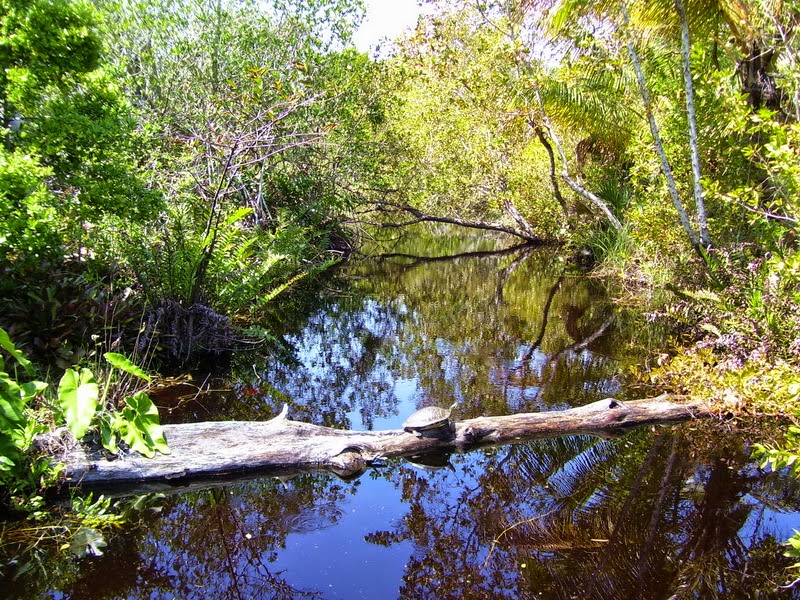
October 23, 2014 – Bailey’s General Store is at the heart of Sanibel.  Literally, it is in the middle of the wide part of the island.  Functionally, Sanibelians go there often to acquire the basics for everyday life – namely, groceries and hardware. Bailey’s is in a ground-level building that pre-dates hurricane code, and it has a long covered sidewalk in front, part of which is decked out with rocking chairs, a few small tables, and other chairs.   The other part of the covered front walk is where all the doorways into the grocery and hardware store are located.  The center doorway is the most frequently used entrance, and that’s where the manager/owner Richard Johnson (married to Mead Bailey Johnson) often permits nonprofit organizations to set up a table from which raffle tickets are sold or information is dispensed. Turtle on a log on Chowder Pond, in our back yard. My friend David and I were scheduled to sit at a table there on Monday, for tw...

Knowing the Natives

Image
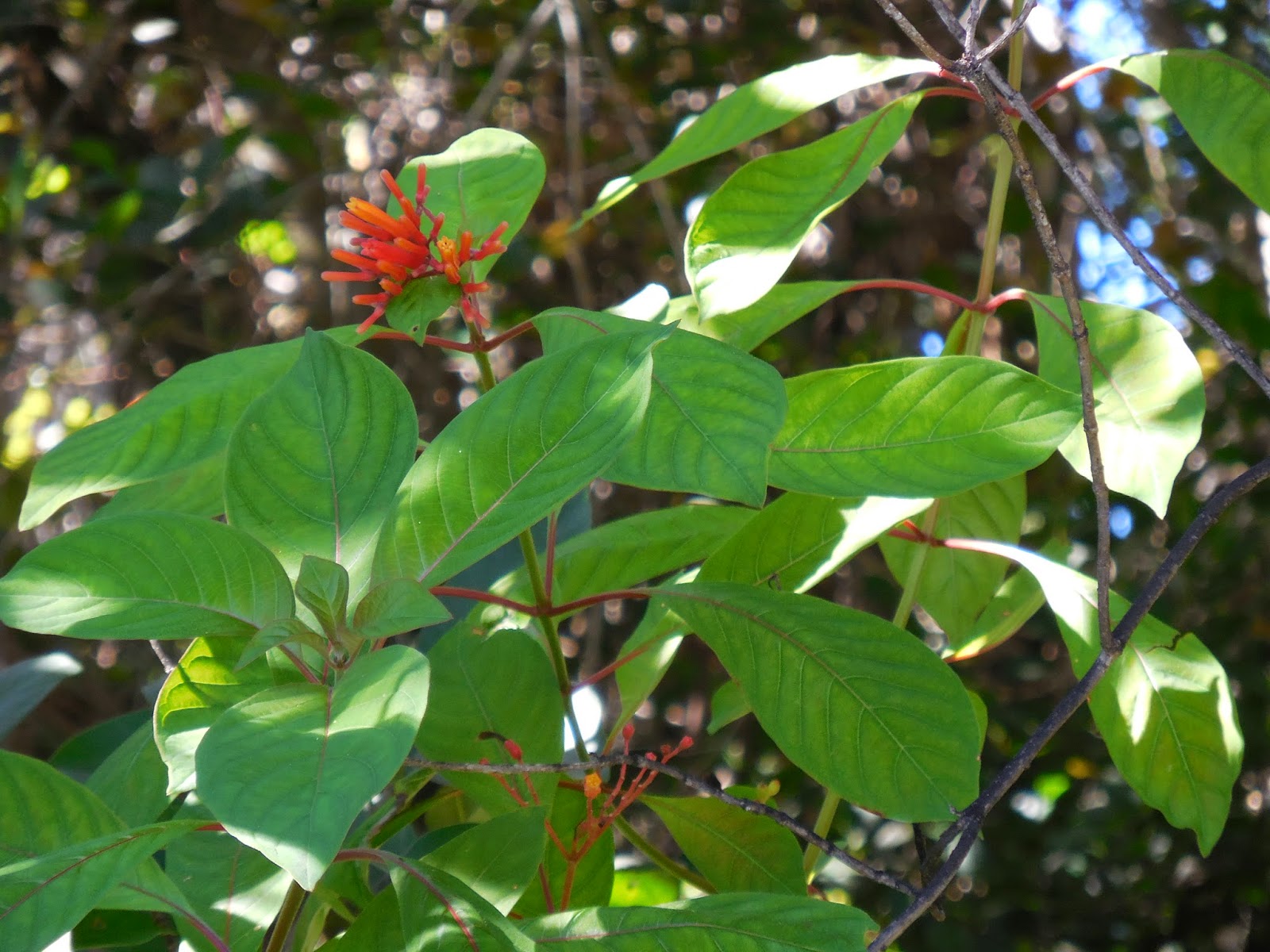
October 21, 2014 – My friend Phyllis conducts tours of the grounds at the Sanibel city hall, where numerous native plants grow.  The tours are not about city government; they are about what grows well on this fragile barrier island – plants that do not need fertilizer and that can survive droughts. The tours are free and no reservations are needed.  For property owners, it is a bargain and a joy to listen to the information that Phyllis provides.  In her sweet voice, she tells little stories about each plant.  She needs no notes; she knows it all by heart. Phyllis is the chair of the city’s vegetation committee.  She devotes much time to this volunteer job.  The committee's members inspect properties that are being developed; they help to ensure that native plants are protected and replaced when necessary. A firebush bloom. That committee also does much to educate new property owners as well as longtime residents like me, who have forgotten what ...